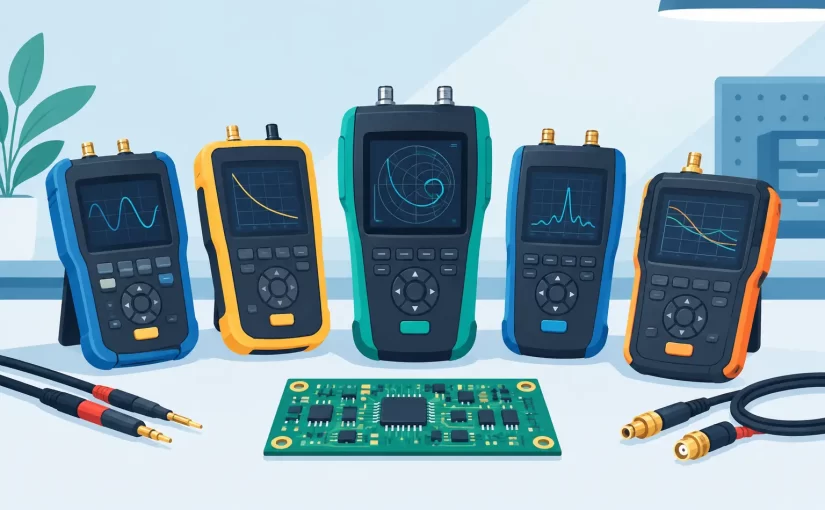
A failed 0402 capacitor does not wait for a bench instrument, a clip lead setup, or a second pair of hands. The best handheld impedance analyzers reduce the distance between a suspected component and a defensible measurement, especially when troubleshooting populated PCBs, sorting SMD parts, or verifying incoming components.
For many repair and production tasks, the right handheld instrument is not simply the smallest LCR meter available. It must provide useful test frequencies, stable contact at the component, sufficient basic accuracy, and readings that can be interpreted in the circuit context. The best choice depends on whether the work centers on loose parts, board-level diagnostics, high-frequency capacitors, inductors, ESR, or documented quality-control measurements.
What Makes a Handheld Impedance Analyzer Useful?
Impedance is more than resistance. A real component may exhibit capacitance, inductance, equivalent series resistance (ESR), dissipation factor, quality factor, phase angle, or a combination of these characteristics at a given test frequency. A handheld impedance analyzer or advanced LCR meter applies a known AC stimulus and reports the resulting electrical behavior.
That distinction matters on modern boards. A ceramic capacitor that appears acceptable at a low test frequency can behave differently at 100 kHz or 250 kHz. An inductor’s DC resistance does not establish its AC impedance. A capacitor with elevated ESR may cause power-rail instability even when its nominal capacitance still appears close to specification.
Portable instruments also impose practical constraints. Test leads are flexible but can add parasitic inductance and capacitance, pick up noise, and make repeatable contact difficult on fine-pitch assemblies. For SMD work, direct tweezer-style probes often provide a faster and more controlled measurement path.
The 7 Best Handheld Impedance Analyzer Fits
There is no single best handheld analyzer for every electronics task. The following categories identify the capability set that produces the best result for a specific workflow.
1. Best for Direct SMD Measurement: Tweezer-Style LCR Instruments
For technicians locating questionable resistors, capacitors, and inductors on a populated PCB, a tweezer-style instrument is usually the most efficient format. The probes contact both terminations directly, allowing the user to measure a component without balancing loose leads or positioning clips in a crowded area.
This approach is particularly valuable for 0201, 0402, 0603, and similar SMD packages. It also reduces the time required to sort loose parts from reels, trays, or repair bins. Smart Tweezers and LCR-Reader instruments from Siborg Systems are designed around this direct-contact measurement method, with configurations ranging from compact budget instruments to advanced Bluetooth-enabled tools.
In-circuit results still require judgment. Parallel components, semiconductor junctions, and connected power rails can influence the reading. Direct probing speeds up diagnosis, but it does not eliminate the need to isolate a component when the circuit topology makes a measurement ambiguous.
2. Best for High-Frequency Capacitor Work: 100 kHz or 250 kHz Testing
Test frequency should be a purchase criterion, not a secondary specification. Low-frequency measurements can be suitable for many general-purpose components, but higher-frequency testing is more revealing for MLCCs, small inductors, switching power supplies, RF-adjacent circuits, and low-impedance capacitors.
A 100 kHz test capability is a practical minimum for many professional capacitor and ESR applications. A 250 kHz option extends useful analysis for users who need closer alignment with high-frequency operating conditions. It is not automatically better for every component, since component datasheets specify measurement conditions for a reason. The goal is to select an instrument that can test near the frequencies relevant to the failure mechanism or acceptance requirement.
3. Best for Production Verification: High Basic Accuracy
For incoming inspection, repair documentation, and controlled production work, basic accuracy matters more than a long feature list. An instrument with 0.1% or 0.2% basic accuracy provides a stronger basis for distinguishing actual component variation from measurement uncertainty.
Accuracy specifications should be read with their conditions attached. Check the specified frequency, measurement range, test signal level, and calibration interval. A headline accuracy number does not guarantee identical performance at every impedance level or at the upper end of the frequency range.
Repeatability is equally important on the bench. If operators cannot contact the same small component consistently, an accurate measurement engine will not solve the workflow problem. Probe geometry, contact pressure, and clean test surfaces all affect usable results.
4. Best for ESR Troubleshooting: Instruments With ESR and LCR Modes
Capacitor failures often appear as increased ESR rather than an obvious loss of capacitance. A handheld analyzer that reports capacitance, ESR, and related LCR parameters gives repair specialists a more complete diagnostic view, particularly on switching regulator outputs and aging electrolytic capacitors.
ESR should not be treated as a pass-fail value without context. ESR changes with capacitance, voltage rating, construction, temperature, and frequency. Compare the result with the component type, circuit role, and manufacturer data when available. A very low ESR reading can also be affected by parallel capacitors on a board.
5. Best for PCB Fault Isolation: Oscilloscope and Analog Signature Capabilities
An impedance measurement is most useful when it can be combined with another diagnostic perspective. Instruments that integrate oscilloscope functions or Analog Signature Analysis can help identify differences between equivalent circuit nodes, compare a known-good board with a suspect board, and assess semiconductor-related behavior.
This capability is not necessary for simple component sorting. It becomes valuable when the fault is not isolated to one visibly damaged part and the technician needs to compare circuit behavior without immediately powering the board. For repair organizations handling mixed boards and intermittent faults, combining measurement functions can reduce tool changes and bench space.
6. Best for Traceable Quality Work: Calibration-Supported Instruments
A measurement is more useful in a quality system when its calibration status is documented. Laboratories, contract manufacturers, and organizations with audit requirements should consider handheld instruments supplied with NIST Traceable Calibration Certificates or supported by a defined calibration process.
Calibration documentation does not replace proper measurement technique. Users still need to follow zeroing procedures, protect probe contacts, avoid measuring energized circuits, and verify readings with appropriate standards when the application demands it. It does provide a documented starting point for confidence in the instrument’s performance.
7. Best for Digital Records: Bluetooth-Enabled Measurement Tools
Manual transcription is slow and introduces avoidable errors. Bluetooth-enabled handheld instruments can transfer measurements to mobile devices or PCs for recording, comparison, and reporting. This is especially useful when technicians must capture a series of component values, document repair evidence, or share results with engineering teams.
Wireless connectivity should support the work rather than complicate it. Confirm that the application or PC workflow provides the required data format, operating system compatibility, and measurement capture speed. For a technician making a few measurements per day, a standalone display may be sufficient. For repeated inspection or repair documentation, digital capture can save meaningful time.
How to Compare Handheld Impedance Analyzers Before Buying
Start with the components and circuits you measure most often. A repair technician working primarily on compact consumer PCBs will likely value fine-pitch tweezer probes, auto-identification, fast readings, and high-frequency capacitor testing. A quality technician may prioritize basic accuracy, calibration traceability, and repeatable measurement procedures. An engineer diagnosing power electronics may need ESR data, inductance measurements, and waveform or signature-analysis capability.
Then examine the specifications that affect the actual measurement: test frequencies, impedance ranges, basic accuracy, available LCR and ESR parameters, test signal conditions, display readability, battery operation, probe replacement options, and data connectivity. Do not assume that a conventional handheld multimeter can replace an impedance analyzer. A DMM is indispensable for voltage, continuity, and resistance checks, but it does not provide the same AC component characterization.
Also consider the physical point of contact. Test leads remain useful for larger through-hole components and remote nodes. Dedicated tweezer probes are typically faster for small components and dense PCB work. The best setup may include both, rather than forcing one probe style into every measurement.
A handheld impedance analyzer earns its place at the bench when it shortens the path from symptom to evidence. Select the frequency range, accuracy, probing method, and documentation features that match the boards in front of you, then use each reading as part of the circuit diagnosis rather than as an isolated number.