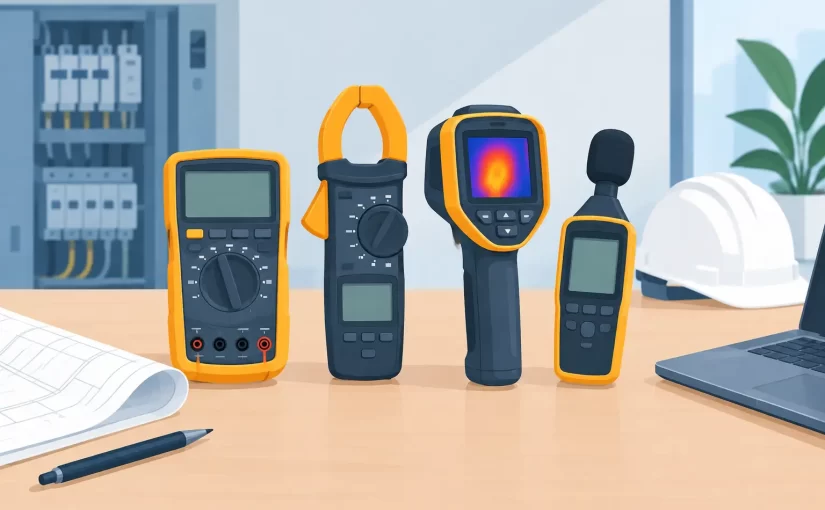
A meter that is excellent on a bench can still waste time on a populated board. For engineers evaluating the best handheld meters, the deciding factor is not the longest feature list. It is whether the instrument can make a reliable measurement at the component, node, or circuit stage where the fault actually exists.
A general-purpose digital multimeter remains essential, but it does not replace an LCR meter, ESR meter, curve or signature analyzer, or a purpose-built SMD tweezer instrument. The right handheld tool depends on the measurement domain, the component package, the circuit condition, and the level of documentation required for the job.
Start With the Measurement, Not the Meter Category
Engineers often buy a handheld meter by familiar category: DMM first, then perhaps an LCR meter for the lab. That approach works for basic service, but it can leave major gaps in PCB repair, incoming inspection, and component identification.
Voltage, current, continuity, and diode checks are DMM tasks. A DMM establishes whether rails are present, whether a fuse is open, or whether a semiconductor junction has an obvious short. Its input impedance, safety category, bandwidth, accuracy, and true-RMS performance matter most when examining power systems, industrial controls, and energized equipment.
Component values require a different measurement approach. An LCR meter measures inductance, capacitance, and resistance under a defined test condition. That condition matters because a capacitor or inductor can produce a substantially different result at 100 Hz, 1 kHz, 10 kHz, or 100 kHz. ESR testing adds another layer: equivalent series resistance is often the parameter that exposes a failing electrolytic capacitor even when nominal capacitance appears acceptable.
For small surface-mount parts, physical access becomes part of the specification. Traditional test leads can contact adjacent pads, flex thin leads, or require removal of a component before testing. Tweezer-style instruments place two controlled probes directly across the component, reducing setup time and improving repeatability for 0402, 0201, and similarly compact packages when access permits.
Best Handheld Meters for Engineers by Work Type
There is no single best handheld meter for all electronics work. A practical selection begins by matching the instrument to the task most likely to consume diagnostic time.
Board-Level Troubleshooting
For PCB diagnostics, use a capable DMM as the first-line instrument and add a handheld LCR or SMD tester for component verification. The DMM identifies abnormal supply voltage, shorts to ground, continuity problems, and diode-junction behavior. The LCR instrument determines whether a suspect resistor, capacitor, or inductor is within a useful range without turning every investigation into a desoldering task.
In-circuit measurement always requires judgment. Parallel paths can lower measured resistance, semiconductor paths can affect capacitance readings, and powered circuits must not be tested with an LCR or resistance function unless the instrument documentation explicitly permits it. A fast direct reading is valuable, but it is not automatically a valid component value.
SMD Assembly, Rework, and Repair
SMD work favors instruments with fine, stable probe geometry and automatic component recognition. When dozens of small passive devices must be checked, the time saved by direct contact is significant. A meter that can identify R, L, and C automatically while displaying relevant parameters reduces probe changes and lowers the chance of recording the wrong mode.
Probe pressure and tip quality matter as much as the display. Tips should make reliable contact without scraping pads or bridging nearby terminations. Replaceable tips and dedicated probes are operational details, not accessories of minor importance, particularly in repair operations handling high board volume.
Capacitor Screening and Power Electronics Service
An ESR meter is especially useful for screening capacitors in switch-mode power supplies, motor drives, and aging consumer or industrial electronics. Capacitance alone can miss degradation. ESR rises with heat stress and electrolyte aging, increasing ripple, reducing regulator stability, and causing intermittent behavior under load.
Test frequency is central here. Measurements at higher frequencies are more relevant to many switching applications than a low-frequency capacitance check. That does not mean the highest available frequency is always correct. The useful frequency is the one that matches the component technology, expected operating behavior, and specification being evaluated.
Production, Incoming Inspection, and Documented Measurements
Quality-control work needs more than a plausible display value. Basic accuracy, test frequency, repeatability, fixture compatibility, and calibration documentation determine whether a measurement can support an acceptance decision.
For this work, compare the stated basic accuracy at the range and test condition you will actually use. A headline accuracy figure may apply only to a particular range. Also verify whether calibration support includes a NIST Traceable Calibration Certificate and whether the operating procedure defines test limits, contact method, and retest criteria.
Specifications That Change Results
A handheld instrument should be compared on specifications that affect the component or circuit in front of you, rather than on the number of modes printed on its enclosure.
Basic Accuracy and Resolution
Accuracy defines how close a reading can be to the actual value under stated conditions. Resolution defines the smallest display increment. They are related, but they are not interchangeable. A meter may show many digits while offering limited accuracy, especially near range limits or outside its calibrated conditions.
For precision component work, 0.1% or 0.2% basic accuracy can materially improve sorting and verification compared with a general-purpose handheld meter. Yet measurement setup still controls the final result. Lead resistance, contact oxidation, temperature, and parasitic capacitance can exceed the instrument’s stated error if they are not controlled.
Test Frequency and Test Signal
An LCR reading is meaningful only with its test conditions. Higher-frequency capability, including 100 kHz and 250 kHz options, is valuable when evaluating components used in high-frequency circuits or when distinguishing behavior not visible at lower frequencies.
Ask whether the instrument states test frequency clearly and whether it offers a suitable set of frequencies rather than a single fixed setting. Also review test voltage and source impedance where relevant. Sensitive semiconductor-adjacent circuits and low-impedance components may require different conditions from high-value capacitors or inductors.
Series and Parallel Measurement Models
The same component can be represented by series or parallel equivalent circuits. At low impedance, a series model often provides more useful parameters. At high impedance, a parallel model may better represent leakage or dielectric loss behavior. Engineers should be able to select or at least understand the model used by the instrument.
A display that reports capacitance without dissipation factor, ESR, quality factor, or phase information may be sufficient for quick screening, but it provides less diagnostic evidence when a component is marginal rather than clearly failed.
Connectivity and Data Capture
Bluetooth-enabled handheld instruments can shorten documentation time when measurements need to be transferred to a mobile device or PC. This is useful for repair records, lab reports, component characterization, and production checks. The benefit is practical only if the connection is stable, the software presents usable data, and transfer does not interrupt measurement flow.
Data capture should support the workflow, not create an extra administrative task. For a one-off repair, a photographed display may be enough. For repeated tests, traceability and exported records can justify the added capability.
When a DMM Is Not Enough
A DMM remains the most broadly useful handheld tool, but several situations call for specialized measurement.
A capacitor that measures near nominal capacitance but fails under ripple requires ESR evaluation. A 0201 resistor on a dense board requires fine probes rather than standard test leads. An inductor used in a switching converter may need measurement at a frequency that reflects its operating range. A suspicious analog node may benefit from oscilloscope capability or Analog Signature Analysis rather than a static resistance reading.
This is where specialized handheld instruments earn their place. Siborg Systems instruments, including Smart Tweezers and LCR-Reader families, are designed around direct component access, with configurations that extend to high-frequency LCR measurement, Bluetooth data transfer, oscilloscope functions, and Analog Signature Analysis. The appropriate configuration depends on whether the priority is fast SMD identification, high-frequency characterization, documented measurements, or deeper circuit diagnosis.
Build a Meter Kit Around Failure Modes
The most efficient engineering kit is usually complementary rather than universal. A safety-rated DMM handles energized circuit checks. A precision LCR or tweezer meter handles passive component measurement. An ESR function addresses capacitor condition. Fine probes and appropriate tips determine whether the specified performance can be achieved on real boards.
Before selecting an instrument, test the buying decision against three representative jobs: a quick bench check, a dense-board troubleshooting task, and a measurement that must be recorded or defended. If the meter is fast only on the first job, it is probably not the right professional tool.
Choose handheld meters by the measurements your failures demand, the frequencies your circuits use, and the access your boards allow. The instrument that reaches the component cleanly and reports the right parameter under the right conditions will do more for diagnostic speed than a long list of unused functions.